OFF-ROAD 101:
Legal Access
|
 |
| Topo Map |
|
|
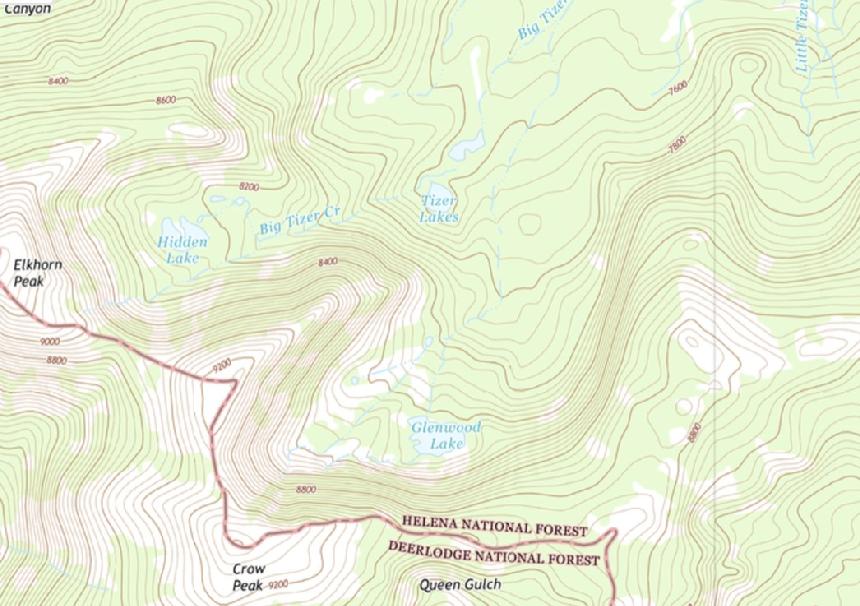
Some time ago, I was spending time with a friend swapping off-road stories. He told me about his attempt to access a small Montana lake that he had recently learned of. However, when he described his route, I quickly realized he was intending to go via an old mining road he had seen. One little issue. That old mining road is now a non-motorized trail (aka; Walk-in only). He said it was perfectly OK because no signs were saying that particular road was closed. ~~ Well, that worked out nicely. I have been looking for a new subject to post on and here is it. That was convenient.Motorized Access To Roads and Trails On Public Lands: Things I Hear People Say...“If there isn’t a sign saying it is closed, the road is open.” I hear this one A LOT. It just does not work that way. The Forest Rules (regulations), which have the effect of law, and the law itself, have no actual requirement for agencies to place signs indicating allowable use and/or access. Just to make it a little more confusing, in this area when they do post signs, the BLM likes to post which trails, on their lands, are open and the Forest Service seemingly prefers to post which trails are closed. A small, but important difference. Even when they do post signs, lots of signs are destroyed by people who falsely believe the lack of a sign will stop a law enforcement officer from issuing a ticket. Well...not so much.The law is prepared for this. Essentially, the law states that YOU are responsible to learn what roads you are allowed to use, how you can use them, and when you can use them. Signs are helpful to have but, the lack of a sign does not legally mean anything. What you need is the appropriate forest map and to take a few minutes before and during your trip to consult it. More on maps later.“It is clearly made for full-sized vehicles so it is legal to drive one there.” That is not how this works. It's not how any of this works. In this area, many walking, horseback riding, snowmobile, and ATV trails were once roads for full-sized vehicles. As well, seeing someone else traveling on a road does not make it legal to be there either. That excuse will not impress an officer or a judge and the other person may have been authorized to be there such as in logging operations.“It shows the road (or trail) on my GPS so it is a legal trail.” This one is becoming more popular as GPS’ has become more common. GPS maps and most non-government forest maps show what is there, not necessarily what is legal. If a road is visible on aerial or satellite photos or earlier maps, it will likely end up on a current GPS or other topo maps. Private roads show up too, but that does not make it right for you to trespass there either. Few maps show if a road is private. However, MVUM and Forest Visitor maps do show which forest roads are closed, open, seasonally restricted, or vehicle type restricted. (Note: The Forest Service has recently started offering some GPS-enabled Motor Vehicle Use Maps but they don’t cover much of Montana yet.) And, of course, I have seen multiple GPS applications showing bad road/trail information. So try to keep that in mind too.“My buddy has been going there for (place # of years here) and he has never received a ticket.”Not having been caught has nothing to do with something being lawful or not. I went about 10 years without seeing a single Forest Service or BLM officer, in the forest. Then, I ran into the same one about 8 times during one three or four-month span. Officers are, admittedly, often few and far between so your odds of getting caught may be small but, they are out there.“Nobody ever really gets in trouble anyway.” Just because it is not on the evening news does not mean it does or did not happen. Yes, the vast majority of penalties are small. However, the penalties for violating these rules can still be hard to swallow. The regulation states: “It is prohibited to possess or operate a motor vehicle on National Forest System lands on the...National Forest other than in accordance with these [travel] designations (36 CFR 261.13). Violators of 36 CFR 261.13 are subject to a fine of up to $5,000, imprisonment for up to 6 months or both (18 U.S.C. 3571(e)). This prohibition applies regardless of the presence of signs.” Note that fines can double for organized groups. Face it, you probably don’t want to be one of those who do get caught.How to stay legal: The Forest Service states; “It is the responsibility of the user to acquire the current Motor Vehicle User Map (MVUM). An MVUM shows the National Forest System roads, National Forest System trails, and the areas on National Forest System lands…that are designated for motor vehicle use pursuant to 36 CFR 212.51.” These MVUM maps cover a smaller area or areas and are a little more precise than the Forest Visitor Maps. However, in many areas, an MVUM is not available yet. In that case, you should acquire a Forest Visitors map. MVUMs are free and Forest Visitor Map hard copies are usually $14.00. Some maps are available for download too. These maps will tell you what roads are open, the authorized type of vehicle(s), and when they are open/closed in the case of seasonal restrictions.National Forest Service Maps Page: CLICK HEREThe real reason all this matters: You may or may not care if you get a ticket, as I stated above, they are usually small. But the real danger of traveling closed roads, in my opinion, is less about getting a ticket but more about losing our access. Those who don’t care or don't know enough to care are a danger to our access. Bumping into FS or BLM law enforcement is pretty uncommon, in many areas. This makes people think they can get away with their transgressions scot-free. Remember, just because an officer did not see the transgression does not mean they cannot tell it occurred. Not getting a ticket may be nice but, if you are part of the reason more access is closed off, we ALL pay.Now I hope you know a little more about access. Take a little time to learn about the MVUM and the Forest Visitor Maps. They contain a good deal of information YOU need to keep you on the right road.Wheel Safe!
Richard
|
|